


Tip
to teach proper pronunciation:
Yet proper
pronunciation has played an important as a major part of learning the English
language. The number of words with similar sounds but different meanings can
cause much confusion if correct pronunciation is not taught and learning
pronunciation by drill is another popular method and can be effecting for some
particular when combined with the study of the inconsistent pattern of English
spelling. In order to teach pronunciation properly we have to follow some following
steps:
Step one: Introducing phonemes
The phoneme is the one sound which
makes the distinct difference between similar words. For example, in the “at”
family of words (cat, fat, mat, sat) the phoneme is the beginning letter ( /c/,
/f/, /m/, /s/) using phoneme to teach pronunciation focus on these distinct
units of sound: the best way to begin is by having students listen for and
identify these differential sounds; have students repeat the sound ‘tip’,
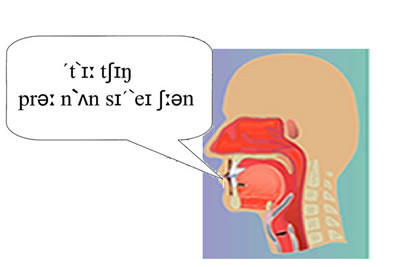
‘dip’, ‘tuck’, ‘duck’. Drawn the diagrams of how to hold the lips and tongue
can also be helpful. Moreover, visual learners may also benefit from the
symbols of the phonetic language to help differentiate between phonemes that
are written the same but sound different for example the ‘th’ in the two words
‘thank’ and ‘there.
Step two: practice phonemes
Once students have grasped the
concepts and can identify phonemes, they will need to practice making the sound
accurately. Pronunciation diagram is very important; the sound likes ‘r’ and
soft ‘g’ and others sound are articulated inside the mouth and they can be
frustrating for students to try and duplicate. Diagrams of correct positioning
of the mouth and tongue for these sounds can be found in many books and blown
up for larger classroom. Learning a second language require a reprogramming of
the brain, new neural path must be created to process the new information.
Step three: words pronunciation
When teaching on the phoneme level,
we take noise and make them significant and when we work on pronunciation a new
set of barriers appears. By the way, fear of failure makes them stiff and
nervous and this is after readily apparent in their demeanor; to relieve such
anxiety, repetitive verbal game such as Jazz chants, hand clap, rhymes and
other structured activities can help them and it can allow students to
concentrate on pronunciation and intonation and it will help to boost self
confident.
Finally: a word on accents
The main objective here is not to
achieve some hypothetical standard of English pronunciation, but to merely
ensure that all students can be readily understood. Game can be useful here to
break the ice lesson tension about accents. Impersonations are a won markedly
wonderful to help students improve their pronunciation and have a fun as well.
The students will notice that they are improving their pronunciation through as
they mimic the speech pattern of their favorite actors and celebrities.
Tips for teaching Vocabulary:
Teaching vocabulary is the most
difficult task for English teachers. They need to understand the children
nature and teach them accordingly because in the class they are mix level of
students (heterogeneous) thus students need to give more exercises and make
them to practice until they gain perfection. Actually, teaching vocabulary can
also include completing the phrases and matching between cities and places. An
exercise correcting sentences can also help a lot of High school English. We
can use power point for presentation to boost memory power of a student.
Since the students need to be
motivated to learn new words constantly, it is important that it is as
interesting as possible and teacher can vary the types of exercises strategies
and activities using the four stages of vocabulary learning: it is important
that it is as interesting as possible teacher can very the types of exercises
strategies and activities using the four stages of vocabulary learning:
Stage 1: Noticing the words
the visual element:
. Flash cards,
.Pictures
Stage 2: Recognition:
True/
False,
Categorize
the words,
Matching
( this category is huge with both open and closed types of exercises). Matching
the word to its definition, L1, L2 opposites, adjectives and nouns, verbs and
adverbs, word to the picture, match two words that go together.
.Multiple
choice
.Drawing
the word
.Bingo
game
.
Circle the words you hear
Stage
3: production
.Answering
the questions
.Guessing
games: I am thinking of
.Picture
description
.Miming
Some
basic tips and strategies for practicing new vocabulary:
.Personalize:
teacher can ask ‘Do you have a dog at home?’ and ‘what animals do you like
best?’ .
.
Teacher numbers of each word: students say the number of each word as
it is called or show the number of fingers for controlling the level of
classroom noise.
.I
am thinking of a word: teachers describes the word and students guess the
meaning.
There
are four stages in acquiring new words:
.
The learner notices the new word ( with help).
.The
learner learns to recognize it( with help).
.The
leaner recognizes it on his or her own.
.The
learner can both recognize and product it.
Ways
to make learning new words interesting: make the lesson as
enjoyable as possible if you
enjoy
your work, the students will en joy your
lesson.
How to teach kids time management
skills:
‘Time and tide wait for none’. This
proverb should be assimilated to our younger generation. Actually, when the
time is lost, it can’t be regained. A proper time management can help in
minimizing work pressure and it’s also very significant to work effectively in
this fast moving era and it should be learned in a very early age thus it will
become habit.
Children always learn better when
they expose themselves to experiencing things practically so that there are
some of the tools that teachers can use to students aware of the time
management skills:
1-Make a planner with dates and
enough space where students can write their assignments, tests or projects to
be done. By this ways students can better plans their activities.
2-Write downs the major tasks or
assignments in bold letters so that these can catch your students notice each
time. Update the planner once the work is done.
3-They should manage time for
sleeping, playing, studying, and eating a part from other activities. These are
major tasks that we do each day.
4-Ask your students to suggest you
some time saving tips. By this way students would be encouraged to manage their
time properly.
5-Studying smaller amounts of
information for several days is more effective than one marathon all-nighter so
that the kids should be encouraged to finish their homework in due time so that
they would not become a burden in the eleventh hour.


0 comments:
Post a Comment